


Read time:
IMPORTANT: From May 2026, this newsletter will ONLY be sent via email to those in Synergy’s distribution list, not published as a post here. We’re endeavouring to migrate those subscribed via the Toolkit, but some may get lost in the way. To ensure you receive future issues, please get on Synergy’s distribution list via the link below. The newsletter remains free to all.
Hey hey – lots to talk about in metals, stocks, and above all, opportunities.
Investor, corporate? Get on our distribution list →
I compiled my first cheatsheet of grades per deposit type nearly 20 years ago.
It was clear to me early on, as a non-geo working in the sector, that grade was a paramount concept to grasp and internalise, as fast as I could.
At the time the cheatsheet was VERY brief note on my phone. Working with my father, a copper porphyry expert who worked for BHP most of his career, I was lucky to have him ready and happy to allay my relentless curiosity. He was the source!
Back then, I was a new architect. If you had told me then I’d be obsessing daily about commodity prices and forecasts, I’d have said you were nuts. But the mining sector had already captured my full attention and my life was going to change. Investing would come a bit later.
But I digress. We’re here to talk about grades and why they matter to mining investors.
Let’s get into it.
I’m sure you’ve heard the popular saying regarding ‘grade is king‘. Turns out, life is always more nuanced than that.
At the individual deposit level, grade is king, but when comparing two or more deposits it is not,
-Sam Ulrich, Aurum Analytics
Ha! Nuance.
Welcome to our newsletter with insights on metals, mining and energy transition investing.
I remember sitting in my dad’s office and asking endless questions about various concepts and ideas. He was always excited and eager to explain as geology was his passion.
My original note held only 3 items. Gold, copper and silver.
At the time, as we used to manage local operations for foreign exploration clients (among other things), those were the commodities we worked with the most. Diablillos, Pirquitas, Cerro Negro, Los Azules, were some of the projects we worked on.
I think all mining investors (and certainly those contemplating the sector) need at least a basic knowledge of grades and, more specifically:
- Typically economic grades for deposit types of interest
- Equivalent grades are its calculation
- Apparent vs true widths
This information will help you predict and prepare for positive (and negative) impacts on your portfolio.
Grade
Let’s start with grade.
Quite simply, grade the amount of valuable minerals/metals per unit of materials to be processed. When we are looking for economic projects (i.e. those that can be mined at a profit) we’re basically looking for those where the concentration is ABOVE the average on earth for the mineral/metal. Ideally, a LOT higher than average.
Going back to Sam’s quote, where is the nuance? I’m glad you asked. Because what’s high for copper porphyry may be low for vein systems and so on. A grade that is ‘just right’ for one type of deposit, may not be enough for another type, due to a myriad of factors, including:
- depth
- impurities
- strip ratios
- processing method
- applicable extraction techniques, etc
If you’re starting out, here’s a simple (yet way more complex than my original one!) for 2 of the most common deposit types and their associated grades. Save the image to your phone or computer so you can refer back, whenever you need to.
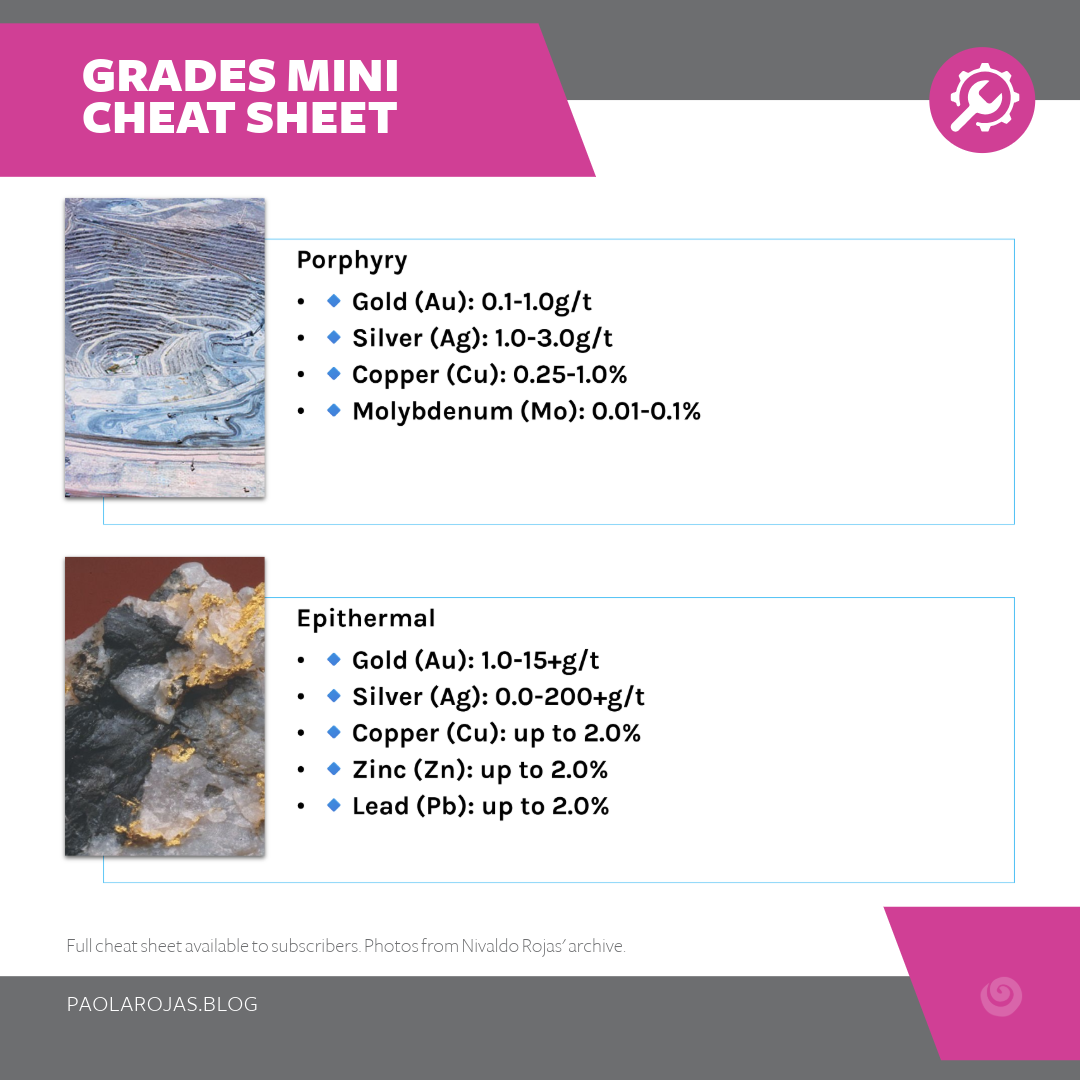
*Full cheat sheet linked below.
Grade equivalent
This is a topic that causes a lot of controversy. Many experts and market participants are strongly opposed to its wide use. And there are strong reasons for this given it can certainly be abused to give the wrong impression (and mislead investors).
But there are some cases where its use is appropriate, and can be a valuable tool. So it’s important to discern which one before becoming suspicious.
Grade equivalencies are the practice of bundling up different minerals/metals into one figure, to simplify results and clear some of the noise that one single line of drilling results may include. You’d take the prices of secondary elements, and add on to the main metal/mineral.
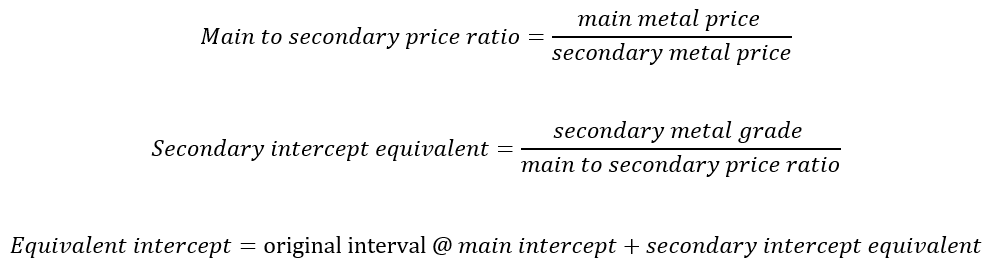
Best used when
- Gold and silver deposits tend to be reported as AuEq given their higher relative value (versus say, base metals)
Can be misleading
- Polymetallic deposits. This post has a well-rounded breakdown I highly recommend.
Width
Another related concept of great importance is width, also called thickness. Essentially, when a company reports their exploration results they’ll include both grade and how long the interval is, where such grade was found. With these details, you can even compare two deposits.
Generally, a good drill result will feature economic grades AND thickness of at least:
- Copper → open pit: 100m; underground: 5% over 2m
- Nickel → open pit: 20m
- Gold → open pit: 100m; underground: 5g/t
- Uranium → open pit: 0.1% over 100m; underground, high grade: 1% over 2m
It’s also important to differentiate between true and apparent width. Drill holes may intersect a mineralised body at an angle, thus the true width may be narrower than reported. Always seek to find, whether looking at reports or news releases, any clarification from the company to know which one is being reported (if there is no mention, it’s likely apparent width).
This is, of course, a simplification but it’s a good place to start.
Grades can be a terribly nuanced topic that investors can study for years. My original cheatsheet may have had only 3 items, but over time it got chunkier and chunkier and today is a double entry chart with 13 elements and 14 deposit types plus examples (and guess, what you can access the full current version below!).
If you enjoyed this, please share it with a friend. The energy transition requires more savvy, committed investors and supporters joining in, to fully enable it.
That’s it for today.

A popular tweet from last month
Keeping track of what resonates is a great indication of investor sentiment. This one got a lot of attention!

In recent related news…
- Copper is now in the biggest contango in over 20 years.
- China keeps eyeing Australian investments as the relationship between the two nations improves
- BHP wants to acquire Anglo American to get immediate access to MORE copper. Bullish!
If you enjoyed this…
- Become a member to access all toolkit topics and research
- Get started with the eBook, Mining Investing 101

Disclaimer: Opinions and materials presented are not investment or financial advice and are intended for informational and educational purposes only; please consult a financial advisor before investing. Companies mentioned publicly may be held and/or clients, except within the member section. Content might contain affiliate links. By reading or sharing, you agree to our full disclaimer.
Investor, corporate? Join Synergy Resource Capital’s distribution list for our newsletter and updates.
 Mining Investing Toolkit