A scoping study in mining is the initial, high-level evaluation of a project’s potential economic, technical, and environmental viability, determining if it warrants further investment.
It assesses the feasibility of extracting mineral resources, often using “back-of-the-napkin” calculations, conceptual models, and early-stage data to estimate project scale, costs, and risks.
These studies are typically conducted before a PEA.
VMS are vital sources of copper, zinc, lead, gold, and silver. They form on or near the sea floor by hydrothermal activity in submarine volcanic environments. These often high-grade, polymetallic deposits form as layers or lenses of sulphide minerals, frequently associated with modern or ancient “black smokers”.
In terms of minerals, these deposits are primarily composed of iron sulphides (pyrite, pyrrhotite) along with chalcopyrite, sphalerite, and galena.
A SEDEX deposit (Sedimentary Exhalative) is a major type of ore deposit, primarily zinc, lead, and silver, formed by mineral-rich, hot water (hydrothermal fluids) emerging from deep within sedimentary basins onto the seafloor, precipitating metals as layered sulfides with sediments.
Iron Oxide Copper-Gold (IOCG) deposits are major, diverse mineral deposits rich in copper (Cu), gold (Au), and often uranium (U), characterized by abundant iron oxides (magnetite/hematite). They are a globally significant source for these metals plus other critical elements like REEs and Cobalt.
Gold + silver deposits formed 5-10km below the surface, with moderate to high grades. A type of hydrothermal deposit. also called orogenic, greenstone-hosted and shear-zone hosted.
More than 75% of the gold recovered by humans through history belongs to this class of deposits.
Maiden drilling seeks to assess the presence of mineralisation in greenfield areas, most often a new project.
Thus, risk is higher in this type of drilling as the goal is to further understand a relatively unknown region or project that has not seen any previous drilling or only contains limited historical indications.
Infill drilling involves drilling new wells in between existing ones to increase the density of wells in an oil field or mining project.
This practice is used in resource extraction to improve the accuracy and confidence of resource modelling and estimates, and is especially useful during economic studies.
In O&G, also used to increase production, or accelerate it by enhancing the connectivity between injection and production wells.
Rare earths are a group of 17 metallic elements in the periodic table: the 15 lanthanides plus scandium and yttrium. Although they are called “rare,” they are not particularly rare in terms of abundance; the name comes from the difficulty of extracting them in high enough concentrations to be commercially viable.
These elements have unique magnetic, optical, and catalytic properties that make them essential for many modern technologies, such as electric vehicles, consumer electronics, and advanced medical equipment.
An open pit is a large-scale excavation used in open-pit mining, a surface mining method for extracting rock or minerals located near the surface.
This technique involves creating a large open hole, often with a series of horizontal benches, to remove deposits by digging and hauling away large quantities of earth, or “overburden,” to expose the desired ore. It’s the most common method for extracting materials like metallic ores (copper, iron) and nonmetallic resources (coal, uranium) that are close to the surface.
Refers to the secondary enrichment of mineral deposits, where naturally occurring geological processes concentrate valuable metals and elements closer to the Earth’s surface.
This is a natural phenomenon where metals are leached from the upper parts of an existing ore deposit and transported downward by groundwater.
In the oxidation zone, minerals weather, forming acidic solutions that dissolve other primary sulfide minerals. As these metal-rich solutions move downward into the reduction zone, they react with unaltered sulfides, precipitating the metals in a more concentrated form.
This creates a “supergene enrichment zone” where the concentration of valuable metals, such as copper, silver, and zinc, increases significantly, making the deposit more economically viable.
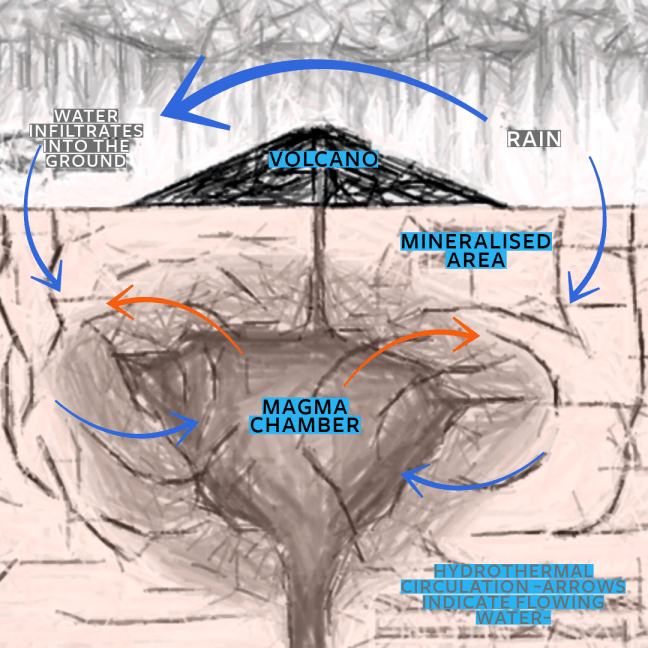
Porphyry copper deposits are ore bodies formed from hydrothermal fluids that originate from a voluminous magma chamber several kilometres below the deposit itself. They are the main source of copper globally.
The deposition of minerals, often of economically valuable metals, into rocks, forming ore bodies or lodes.
For instance, hydrothermal deposition, where minerals are carried by hot fluids and deposited in fractures, or through replacement processes, creating a gold deposit. The outcome of this process is an accumulation of concentrated minerals that may have commercial value, precisely due to this concentration.
Pegmatites are extreme igneous rocks that form during the final stage of a magma’s crystallisation.
To be called a “pegmatite,” a rock should be composed almost entirely of crystals that are at least one centimetre in diameter. The name “pegmatite” has nothing to do with the mineral composition of the rock.
Pegmatites are economically important because they can host a wide range of minerals, serving as primary commercial sources for lithium, beryllium, tantalum, niobium, feldspar, mica, and various gemstones.
A PEA study can be defined as a Preliminary Economic Assessment, a high-level initial study in the mining and resource sector to determine if a project is potentially viable.
Purpose: To assess a mineral resource project’s potential economic viability by providing an initial technical and economic snapshot.
Nature: It is preliminary and based on initial data, which includes Inferred Mineral Resources that are too speculative to have economic considerations applied to them to be converted to Mineral Reserves.
Outcome: A PEA helps determine if a project warrants further, more detailed studies, such as Pre-Feasibility Studies and Feasibility Studies. View more here.
A cut-off grade is the minimum grade of mineralisation required for a material to be considered economically viable to mine and process in a mining operation
Material above this threshold is classified as “ore,” while material below it is considered “waste” or “gangue”. This critical economic concept determines which parts of a mineral deposit are included in resource estimates, influencing profitability, operational costs, market prices, and resource recovery rates.
In mining, tonnage refers to the mass or weight of ore (or other mined material) that is extracted and processed.
It’s a crucial metric for assessing the size and potential value of a mineral deposit, and for planning and managing mining operations. Tonnage is often reported alongside the grade (concentration of the valuable metal or mineral) and cut-off grade (minimum grade for profitable extraction).
This coefficient shows the volatility of a stock vs the systematic risk of the entire market. A beta of 1 means its price activity correlates with the market, <1 shows stability, and >1 is more volatile than the market (theoretically riskier).
Among mining stocks, you’ll often find beta well above 1, especially during exploration. Once a company is producing, risk lowers and beta tends to hover around 1. However, as all indicators and calculations, there are caveats: a solid producer that has gone through a substantial period of outperformance can show values above 1, and a small cap stock that has languished for months can be ‘safely’ placed under 1, thus deeper analysis is important to understand why beta is where it is, at any given time.
A security’s beta is calculated by dividing the product of the covariance of the security’s returns and the market’s returns by the variance of the market’s returns over a specified period. Platforms like TradingView and others show the value in the stock summary.
VWAP, or Volume Weighted Average Price, is a trading indicator that represents the average price at which a security has traded throughout the day, weighted by volume.
It’s calculated by summing the product of price and volume for each transaction, then dividing by the total volume for the period. VWAP is a popular tool for institutional investors and traders to assess the quality of trade executions and identify potential trends.
Condemnation drilling, in the context of mineral exploration and mining, refers to drilling specifically designed to demonstrate the absence of valuable mineralisation in areas intended for infrastructure or other development, rather than to discover new ore deposits.
It’s essentially “sterilisation” drilling, ensuring that areas planned for facilities like processing plants, tailings storage, or other infrastructure are free of economically significant mineral deposits.
An often cited statistic says that less than one project in a hundred will become a mine. So this person is correct, drilling is not the end all, be all.
In fact, it is only the first SERIOUS step. As in it shows intention, and takes a lot of serious money to do!
You can use this process to go over news releases or reports, to assess whether results from a drilling program are promising, just meh or underwhelming.
Please note these answers provide guidance, are educational in nature, and are not a recommendation to buy any specific securities. See the disclaimer below for more important information.
Have a question to ask?
Comment or send us a DM on any of our socials. Anyone can ask, but answers are part of the blog’s exclusive subscriber content.
Disclaimer: Opinions and materials presented are not investment or financial advice and are intended for informational and educational purposes only; please consult a financial advisor before investing. Companies mentioned publicly may be held and/or clients, except within the member section. Content might contain affiliate links. By reading or sharing, you agree to our full disclaimer.
Accredited investor, corporate? Join Synergy Resource Capital’s distribution list for deal alerts and updates.


 Mining Investing Toolkit